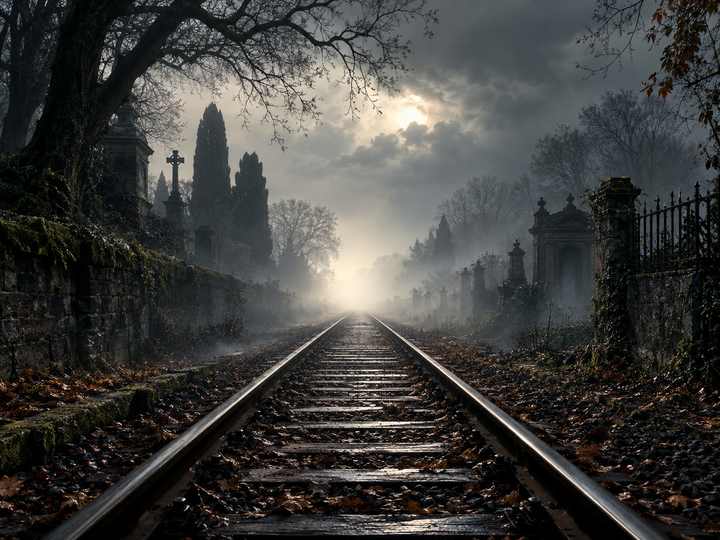
Long before Green Lung turned it into a metal song, London had a railway built to carry the dead.
In 1854, the London Necropolis Railway began transporting coffins and mourners from the city to Brookwood Cemetery in Surrey. At a time when London’s burial grounds were under enormous pressure, the railway offered a remarkable solution: a journey out of the capital for the living and the dead alike.
This was not a ghost train or a piece of Victorian folklore. It was a real service, with a London terminus and trains bound for a cemetery outside the city. For decades, the journey made death part of the railway timetable.
The service did not survive the Second World War. Bomb damage to its London terminus in 1941 brought the operation to an end, leaving behind a strange chapter in the history of the city.
More than eight decades later, that chapter caught the imagination of Green Lung.
Their song “Necropolitan Line” draws directly on the London Necropolis Railway. The band has also cited the 1972 film Death Line as an influence, bringing a second, fictional layer of underground horror into the picture. The railway supplies the historical foundation; the sinister world of the song is the band’s own creation.
That distinction makes the idea more compelling, not less. Green Lung did not need to invent a train that carried the dead. Victorian London had already built one.
And somewhere between the historical record and the band’s fascination with British folklore and horror, an extraordinary piece of railway history found a new destination in heavy music.
THE STORIES BEHIND THE NOISE
SOURCES
https://www.nuclearblast.com/blogs/news/green-lung-reveal-video-for-new-single-necropolitan-line
https://historicengland.org.uk/listing/what-is-designation/heritage-highlights/cemetery-railway-line