
Before “Harvester of Sorrow” became one of Metallica’s heaviest slow-burning songs, James Hetfield had a word in his head.
Infanticide.
Years later, while revisiting the …And Justice for All era, Hetfield remembered being struck by the word itself. He looked at what it meant — the killing of an infant — and said he essentially built a song around it.
But the story that emerged was about more than one violent act.
It was about being trapped.
A MAN WHO CAN’T ESCAPE HIS OWN LIFE
In an older interview later revisited by Metallica, Hetfield described the character behind “Harvester of Sorrow” as a man who had married young, felt trapped by family life and believed his youth had been taken from him.
The frustration turns inward, then outward.
The character becomes consumed by resentment. Drinking, drugs and violence enter the picture. What begins as dissatisfaction with his life becomes something far darker: a man transforming into the source of terror inside his own home.
Decades later, Hetfield reconsidered one detail of that old description. The story did not need to happen in the American Midwest, he said. It could happen anywhere.
The important part was the feeling underneath it.
Being trapped.
Hetfield recognized that feeling as a recurring theme in his writing.
THE WORD AT THE CENTER
That makes the origin of “Harvester of Sorrow” unusually revealing.
The song was not presented by Hetfield as a retelling of a specific murder case. Instead, one brutal word gave him a starting point. From there he constructed a fictional descent into anger, misery and violence.
The word eventually appears at the darkest point of the song, but by then the listener has already been taken through the character’s collapse.
The horror is not introduced all at once.
It grows.
FROM RIFF TAPES TO …AND JUSTICE FOR ALL
The musical history of “Harvester of Sorrow” also stretches back before the album sessions were completed. Metallica’s archive of the …And Justice for All era preserves the song’s development among the band’s 1987 riff tapes, writing material and demos.
By January 1988, the band had a demo of the song. Metallica then recorded …And Justice for All at One on One Recording Studios in Los Angeles between January and May 1988, with the album produced by Metallica and Flemming Rasmussen.
The finished track was credited to James Hetfield and Lars Ulrich.
Its weight came not from speed, but from restraint: a grinding central riff, deliberate drums and enough empty space for the tension to build. Hetfield later described it as the thick, heavy song of the record — comparable in role to “For Whom the Bell Tolls” on Ride the Lightning.
That musical heaviness fits the story perfectly.
Nothing feels like it is rushing toward the violence.
It feels inevitable.
THE MONSTER WAS BUILT, NOT FOUND
That distinction matters when telling the story of “Harvester of Sorrow.”
There is no need to search for a real killer behind the song to make it disturbing.
The origin Hetfield himself described is stranger in its simplicity: he encountered a word powerful enough to trigger an idea, then followed that idea into the mind of someone who believes his life has become a prison.
The result became one of the darkest character studies of the …And Justice for All era.
A word became an idea.
The idea became a trapped man.
And the trapped man became the Harvester of Sorrow.
THE STORIES BEHIND THE NOISE
SOURCES
https://www.metallica.com/so-what/2026-09-07-revisiting-ajfa-2018.html
https://www.metallica.com/songs/harvester-of-sorrow.html
https://www.metallica.com/releases/albums/and-justice-for-all-album.html
https://www.metallica.com/news/2018-09-06-justice-is-done.html
IMAGE CREDITS
Photo: Raph_PH / Wikimedia Commons
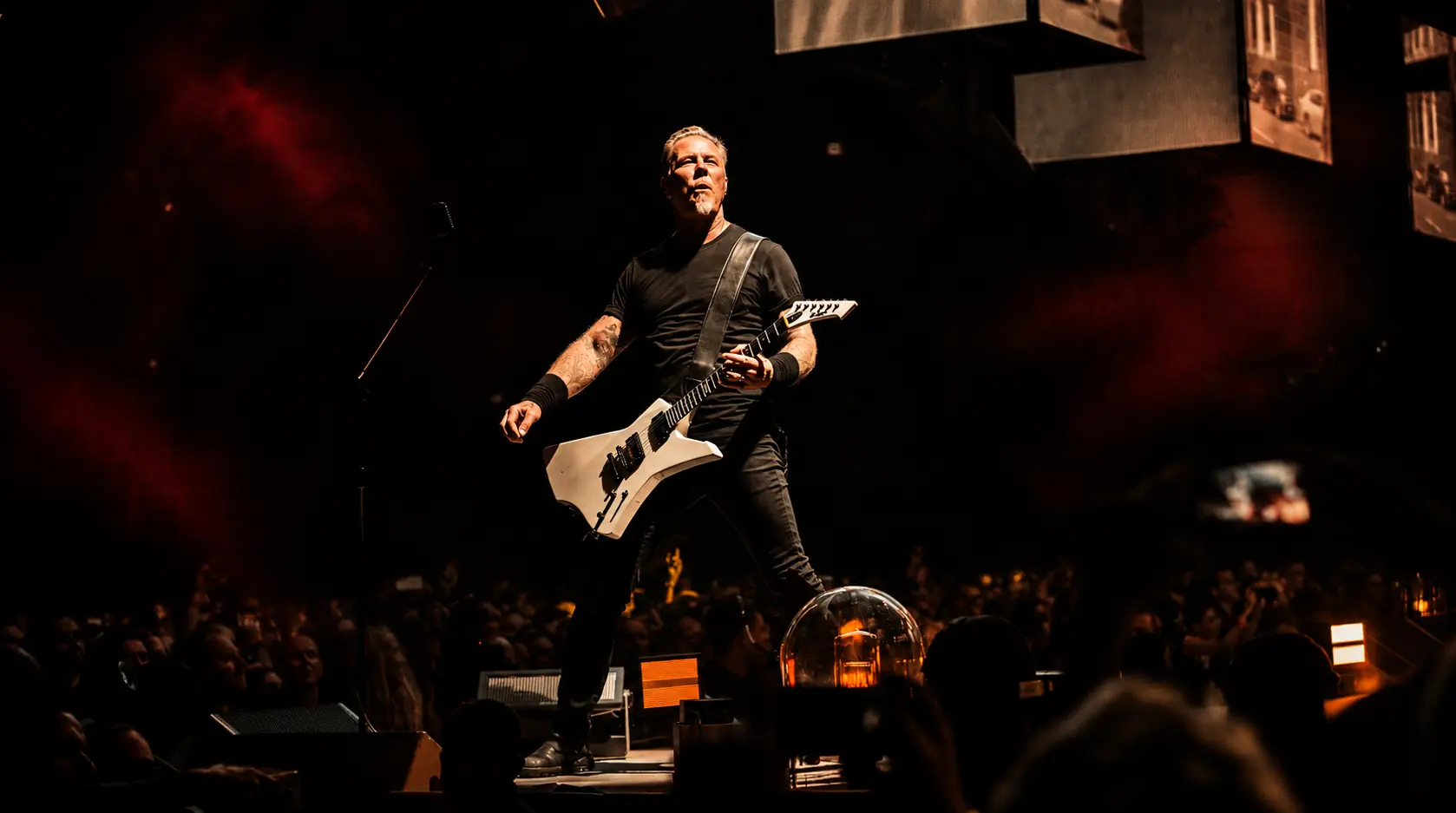
Metallica — The O2, London, 22 October 2017.
Source: Original photograph

License: CC BY 2.0
Modified for Metal Untold: Colour grading and visual adjustments.