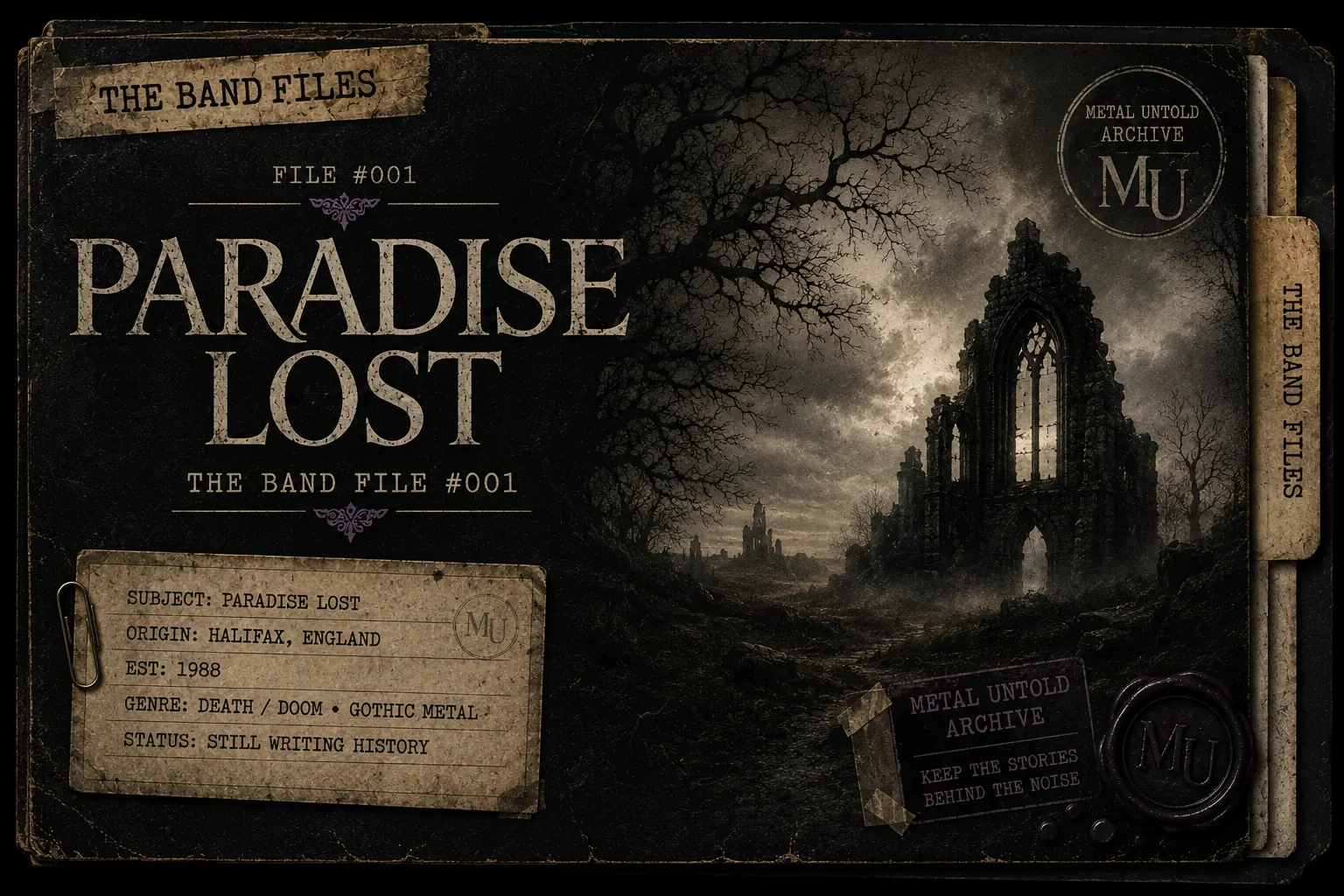
PARADISE LOST · THE BAND FILES · FILE #001
From the bleak beginnings of British death/doom to gothic metal and beyond.
Paradise Lost did not begin as the band most people know today.
Formed in Halifax, West Yorkshire, in 1988, they emerged from the same underground that was pushing death metal toward slower, heavier and more oppressive territory.
The early Paradise Lost sound was raw and crushing — built on death-metal vocals, massive guitars and the suffocating weight of doom. But what makes their story important is not simply where they started.
It is how far they were willing to move.
THE BEGINNING
Paradise Lost formed in Halifax in 1988, with Nick Holmes, Gregor Mackintosh, Aaron Aedy, Stephen Edmondson and Matthew Archer establishing the line-up that would define the band’s earliest years.
Their first recordings belonged firmly to the underground. The 1990 debut Lost Paradise was primitive, bleak and overwhelmingly heavy, combining death metal aggression with the slow, oppressive atmosphere of doom.
But the transformation had already begun.
With Gothic in 1991, Paradise Lost started pushing beyond the boundaries of death/doom. Female vocals, orchestral textures and a stronger sense of melody entered the sound without removing its darkness.
That album would eventually give its name to something much bigger than Paradise Lost themselves.
THE BREAKTHROUGH
The next step was not a retreat from heaviness, but an expansion of what Paradise Lost could sound like.
Shades of God arrived in 1992, pushing the band toward a more melodic and structured form of doom metal. A year later, Icon took that evolution much further. Nick Holmes increasingly moved away from the extreme vocals of the early records, while Gregor Mackintosh’s lead guitar work became one of the band’s defining signatures.
Then came Draconian Times in 1995.
The album brought together the different sides of Paradise Lost with remarkable precision: crushing riffs, gothic atmosphere, memorable melodies and songs that could reach far beyond the death/doom underground.
For many listeners, Draconian Times remains the record that captured Paradise Lost at the exact point where underground darkness met a much larger audience.
THE RISK
After Draconian Times, Paradise Lost could have stayed with the sound that had brought them their greatest recognition.
They chose not to.
One Second arrived in 1997 with cleaner vocals, more restrained guitars and a growing electronic influence. The darkness remained, but its form was changing.
With Host in 1999, they pushed the experiment even further. Guitars moved away from the centre of the music, while synthesizers and electronic textures pushed the band further away from their metal roots than ever before.
For some fans, Paradise Lost had gone too far.
For the band, however, standing still would have been the greater risk.
That willingness to abandon a successful formula became one of the defining characteristics of Paradise Lost — even when the decision divided their own audience.
THE RETURN
After years of experimentation, Paradise Lost gradually began reconnecting with the heavier elements of their past.
The change was not an overnight return to 1991. Albums such as Paradise Lost and In Requiem brought heavier guitars and darker atmospheres back into focus, while Faith Divides Us – Death Unites Us and Tragic Idol pushed further into doom.
Then the circle began to close.
On The Plague Within in 2015, Nick Holmes brought death growls back into Paradise Lost’s music — a vocal style that had largely disappeared from the band for more than two decades.
Medusa followed in 2017, taking the band even deeper into slow, crushing doom and reconnecting unmistakably with the weight of their earliest records.
Obsidian followed in 2020, balancing the different eras of the band rather than simply choosing between them. Five years later, Ascension continued that path — another reminder that Paradise Lost’s story has never really been about returning to one particular sound.
But this was not simply Paradise Lost trying to become their younger selves again.
They returned carrying everything they had learned along the way — gothic rock, electronics, melody, accessibility and experimentation — creating a version of heaviness that could only have come after decades of refusing to remain in one place.
THE LEGACY
Paradise Lost helped open a door that countless bands would later walk through.
Alongside groups such as My Dying Bride and Anathema, they became central to the rise of British death/doom in the early 1990s. But their influence quickly stretched beyond the scene that produced them.
The darkness and atmosphere of Gothic, the melodic weight of Icon and Draconian Times, and even the controversial experiments that followed showed that heavy music did not have to remain trapped inside one identity.
Paradise Lost could sound like a death/doom band, a gothic metal band, a dark rock band or something approaching electronic music — and still remain recognisably Paradise Lost.
That may be the most important part of their story.
They survived not by protecting the sound that made them successful, but by repeatedly putting it at risk.
More than three decades after their formation, their history reads less like a straight line than a journey outward — and eventually back toward the darkness where it began.
ESSENTIAL LISTENING
Gothic — Gothic (1991)
The point where death/doom began opening into something more atmospheric.
As I Die — Shades of God (1992)
A bridge between the brutality of the early years and the more melodic Paradise Lost that followed.
Embers Fire — Icon (1993)
Dark, heavy and immediately recognisable — the sound of the band finding a new identity.
The Last Time — Draconian Times (1995)
Paradise Lost at their mid-’90s peak: accessible without losing the melancholy underneath.
Say Just Words — One Second (1997)
The beginning of another transformation, pointing toward the electronic and gothic-rock experimentation that would follow.
THE BAND FILES
FILE #001 — PARADISE LOST
Start with the five tracks above. Then follow the darkness wherever it leads.
SOURCES & LINKS
Paradise Lost — Peaceville biography & early history
Peaceville — The Lost and the Painless
Metal Hammer / Louder — Gregor Mackintosh on the evolution of gothic metal