
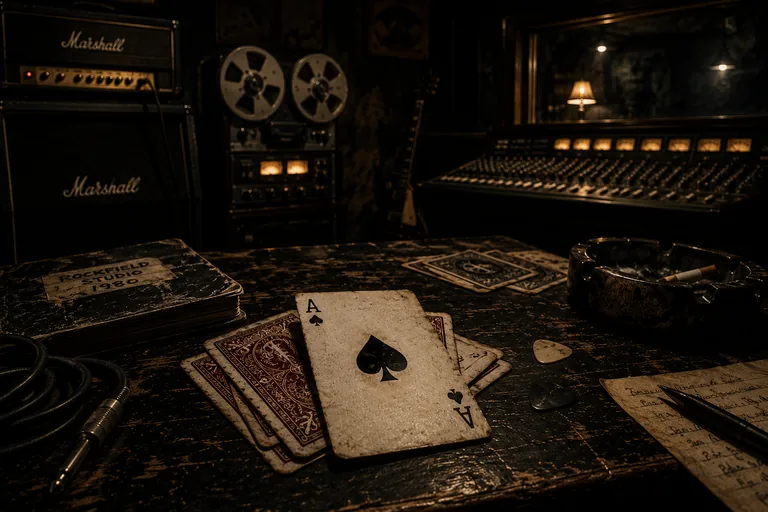
Few riffs announce themselves as violently as “Ace of Spades.”
That opening attack became the sound of Motörhead distilled into seconds: Lemmy’s distorted bass, Fast Eddie Clarke’s guitar and Phil “Philthy Animal” Taylor driving everything forward at reckless speed.
But the version we know almost wasn’t the version we got.
When Motörhead first developed “Ace of Spades” in 1980, the band already knew they had something. An early instrumental version was recorded during sessions at Rockfield Studios, but it was missing two elements that would eventually become essential to the finished song: the famous central riff and its distinctive breakdown.
Producer Vic Maile heard the potential — but he wasn’t satisfied.
According to Fast Eddie Clarke, Maile questioned what the band was doing with the song and pushed Lemmy and Clarke to reconsider the riff. The two began experimenting with it in the studio, something Clarke later remembered as unusual for Motörhead.
Out of that session emerged the riff that would become inseparable from the band.
But Maile wasn’t finished.
The producer kept a cardboard “box of tricks” containing various objects that could be used to create unusual sounds. Among them were woodblocks.
For the song’s breakdown, Maile suggested that Lemmy, Clarke and Taylor play the blocks together.
The band wasn’t convinced.
Their first attempts weren’t exactly precise — the three musicians struggled to hit them simultaneously — but once the sound was recorded and played back, they changed their minds.
The strange wooden clacking stayed.
Then came Lemmy’s lyrics: a rapid-fire collection of gambling imagery — cards, dice, winning, losing and the fatalistic philosophy that would become one of his most famous statements.
Released in November 1980, “Ace of Spades” reached No. 15 on the UK Singles Chart and eventually became the song most closely associated with Motörhead.
Decades later, Fast Eddie Clarke could still describe how simply mentioning its title made people immediately understand which band he had played in.
One of rock’s most recognizable riffs had become inevitable.
But in the beginning, it wasn’t even there.