
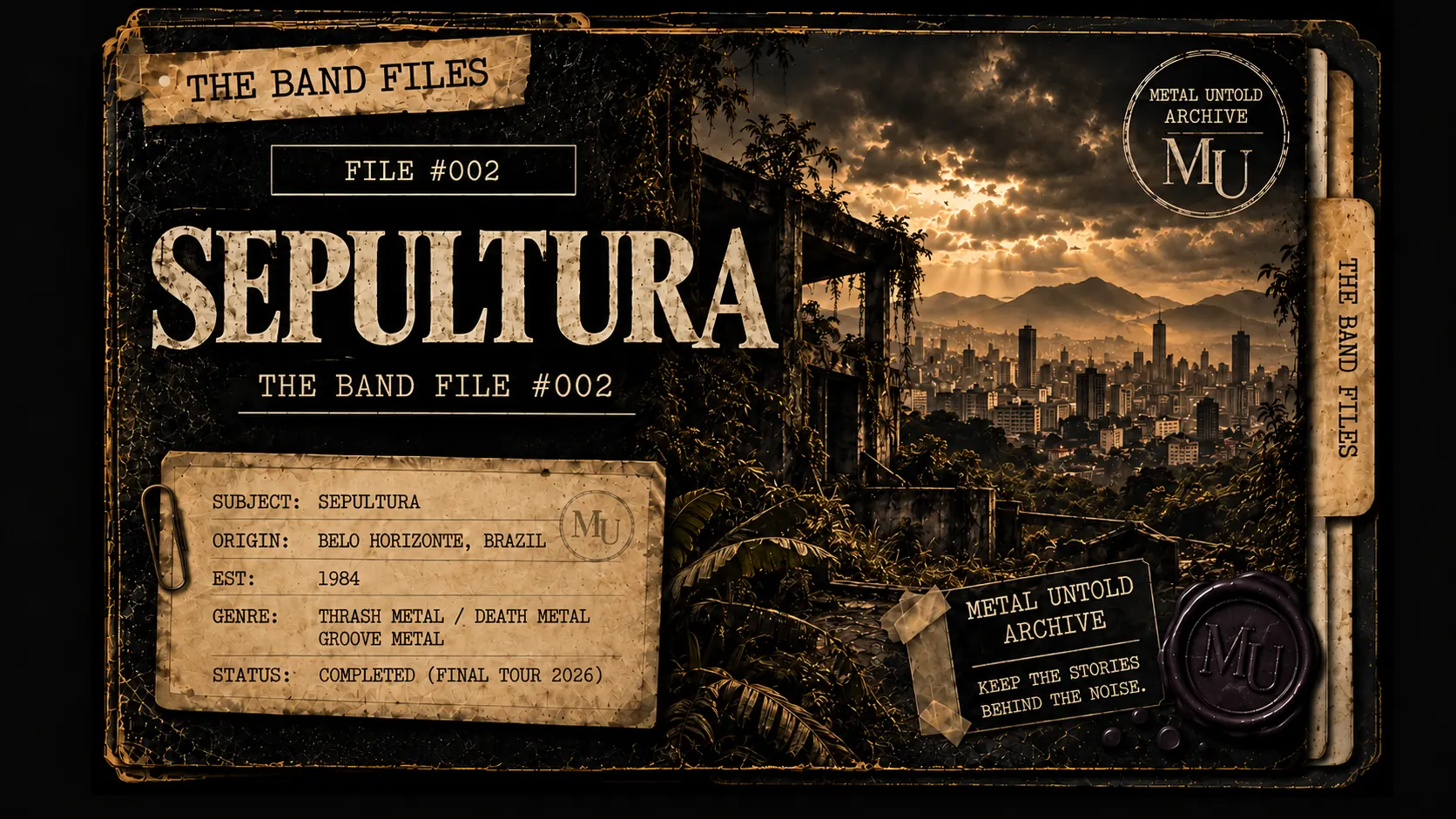
FORMED: 1984
ORIGIN: Belo Horizonte, Minas Gerais, Brazil
GENRE: Thrash Metal / Death Metal / Groove Metal
STATUS: Active — Farewell Tour
PUBLISHED: October 2026
LAST UPDATED: October 2026
FROM BELO HORIZONTE TO THE WORLD
Sepultura’s story is not simply the story of a Brazilian band that became successful outside Brazil.
It is the story of a band that first learned the language of extreme metal, then gradually stopped trying to sound like the world around it — and began bringing its own world into metal.
Formed in Belo Horizonte in 1984, Sepultura travelled from the raw extremity of Morbid Visions to the precision of Beneath the Remains and Arise, before opening their sound to Brazilian rhythm, identity and culture on Chaos A.D. and Roots.
Then, at the height of their international rise, the lineup fractured. Sepultura continued.
That decision created a second chapter that would ultimately last longer than the first. More than four decades after the band began, Sepultura are now approaching the end of that journey on their own terms.
THE BEGINNING
Sepultura was formed in Belo Horizonte, Minas Gerais, in 1984. The band emerged far from the established centres of the international metal industry, and its earliest recordings carried the rawness of an underground group still defining its language.
Morbid Visions arrived in 1986. Schizophrenia followed in 1987 after Andreas Kisser joined on guitar, marking a major step in the band’s development. By the time Beneath the Remains appeared in 1989, Sepultura had moved beyond local underground status and onto the international metal map.
Arise followed in 1991 and extended that momentum. But the most important consequence of those years abroad was not simply a larger audience. Touring outside Brazil changed the way the band saw its own country. Andreas Kisser later recalled that seeing Brazil from the outside gave Sepultura a different perspective on its culture and identity.
FINDING THEIR OWN SOUND
That perspective became central to Chaos A.D. in 1993. The album widened Sepultura’s musical vocabulary: thrash remained part of the foundation, but groove, hardcore and Brazilian rhythmic ideas became increasingly important. The lyrical focus also moved closer to social and political realities.
Kisser has described Chaos A.D. as the point where Sepultura became more ‘Brazilian-ised’ and found a more original sound. That matters because the shift was not a rejection of the band’s past. It was the moment Sepultura stopped being defined mainly by how effectively they could operate inside an existing extreme-metal language and began making their own background part of that language.
Roots would take that idea further.
ROOTS
Released in 1996, Roots pushed Sepultura’s Brazilian identity deeper into the music. The album combined heavy, groove-driven writing with percussion and cultural references that made its sense of place impossible to separate from its sound.
The project included the recording of Itsári with members of the Xavante community in Brazil. Elsewhere, songs such as Roots Bloody Roots and Ratamahatta showed how far the band had travelled from the raw extremity of its earliest recordings.
Roots became the culmination of the Max Cavalera era — and, almost immediately, the point at which that era ended.
THE SPLIT
At the end of 1996, Max Cavalera left Sepultura after a breakdown in the relationship between the band and its management. The dispute has been described from different perspectives over the years, but its consequence is clear: the lineup associated with Sepultura’s international breakthrough fractured at the height of its visibility.
The remaining members chose to continue. American vocalist Derrick Green joined the band, and Against was released in 1998.
Green was not brought in to reproduce Max Cavalera. His arrival forced Sepultura to become something different, and it began a second era that would eventually account for most of the band’s lifespan.
THE SECOND LIFE
The Derrick Green years did not revolve around a single attempt to recreate the commercial peak of the 1990s. Instead, Sepultura kept changing its frame of reference. Nation and Roorback were followed by concept-driven records such as Dante XXI, inspired by Dante’s Divine Comedy, and A-Lex, based on A Clockwork Orange.
Later albums including Kairos, The Mediator Between Head and Hands Must Be the Heart, Machine Messiah and Quadra extended a catalogue that increasingly belonged to a different Sepultura from the one that made Roots — but was still unmistakably part of the same history.
The importance of this period is not simply that the band survived a famous split. Sepultura refused to spend the next three decades functioning as a tribute to its own past.
THE FINAL CHAPTER
In December 2023, Sepultura announced the Celebrating Life Through Death farewell tour, describing the decision to end the band as conscious and planned.
As of October 2026, that farewell is still in progress. The band’s official tour schedule lists further dates, and the final career show has been announced for 7 November 2026 in São Paulo, Brazil.
There is an appropriate symmetry to ending in Brazil. Sepultura spent decades travelling outward from Belo Horizonte. Along the way, the band discovered that its strongest identity did not come from leaving Brazil behind. It came from carrying Brazil with it.
THE LEGACY
Sepultura’s legacy cannot be reduced to one lineup or one album. Beneath the Remains and Arise established the band internationally; Chaos A.D. and Roots made Brazilian identity increasingly central to a sound heard around the world. Kisser has also pointed to later Brazilian bands such as Claustrofobia, Crypta and Nervosa when discussing groups that acknowledge Sepultura’s influence.
The second half of the story matters just as much to understanding the band’s longevity. Derrick Green joined in 1998 and remained the voice of Sepultura for decades. Treating everything after Max Cavalera as an epilogue would erase most of the band’s working life.
The two eras are different. They do not need to compete with each other to belong to the same history.
Sepultura’s story is ultimately one of transformation: from the Belo Horizonte underground to international thrash, from thrash into a more distinctly Brazilian form of heavy music, through a defining split and into an unexpectedly long second life.
The file is almost complete. But as of October 2026, the final page has not yet been written.
DISCOGRAPHY
Studio albums — updated through October 2026
- Morbid Visions — 1986
- Schizophrenia — 1987
- Beneath the Remains — 1989
- Arise — 1991
- Chaos A.D. — 1993
- Roots — 1996
- Against — 1998
- Nation — 2001
- Roorback — 2003
- Dante XXI — 2006
- A-Lex — 2009
- Kairos — 2011
- The Mediator Between Head and Hands Must Be the Heart — 2013
- Machine Messiah — 2017
- Quadra — 2020
ESSENTIAL LISTENING
Beneath the Remains — Beneath the Remains (1989)
The point where Sepultura’s underground ferocity met the precision and ambition that carried the band beyond Brazil.
Arise — Arise (1991)
A snapshot of Sepultura as an international thrash force immediately before its most dramatic stylistic transformation.
Refuse/Resist — Chaos A.D. (1993)
The transition in full view: groove, hardcore aggression and Brazilian rhythm reshaping the band’s identity.
Roots Bloody Roots — Roots (1996)
The clearest declaration of the Brazilian-centred identity that defined the final phase of the classic lineup.
Convicted in Life — Dante XXI (2006)
A deliberate choice from the Derrick Green era, representing the long second life of Sepultura rather than allowing the File to end in 1996.
THE STORIES BEHIND THE NOISE
SOURCES
https://www.sepultura.com.br/band-biography
https://www.sepultura.com.br/post/farewell-tour
https://www.sepultura.com.br/tour
https://www.sepultura.com.br/band-members
https://www.loudersound.com/features/sepultura-story-behind-chaos-ad
https://www.loudersound.com/features/the-story-behind-sepulturas-roots
https://www.loudersound.com/features/sepultura-five-songs-define-career