
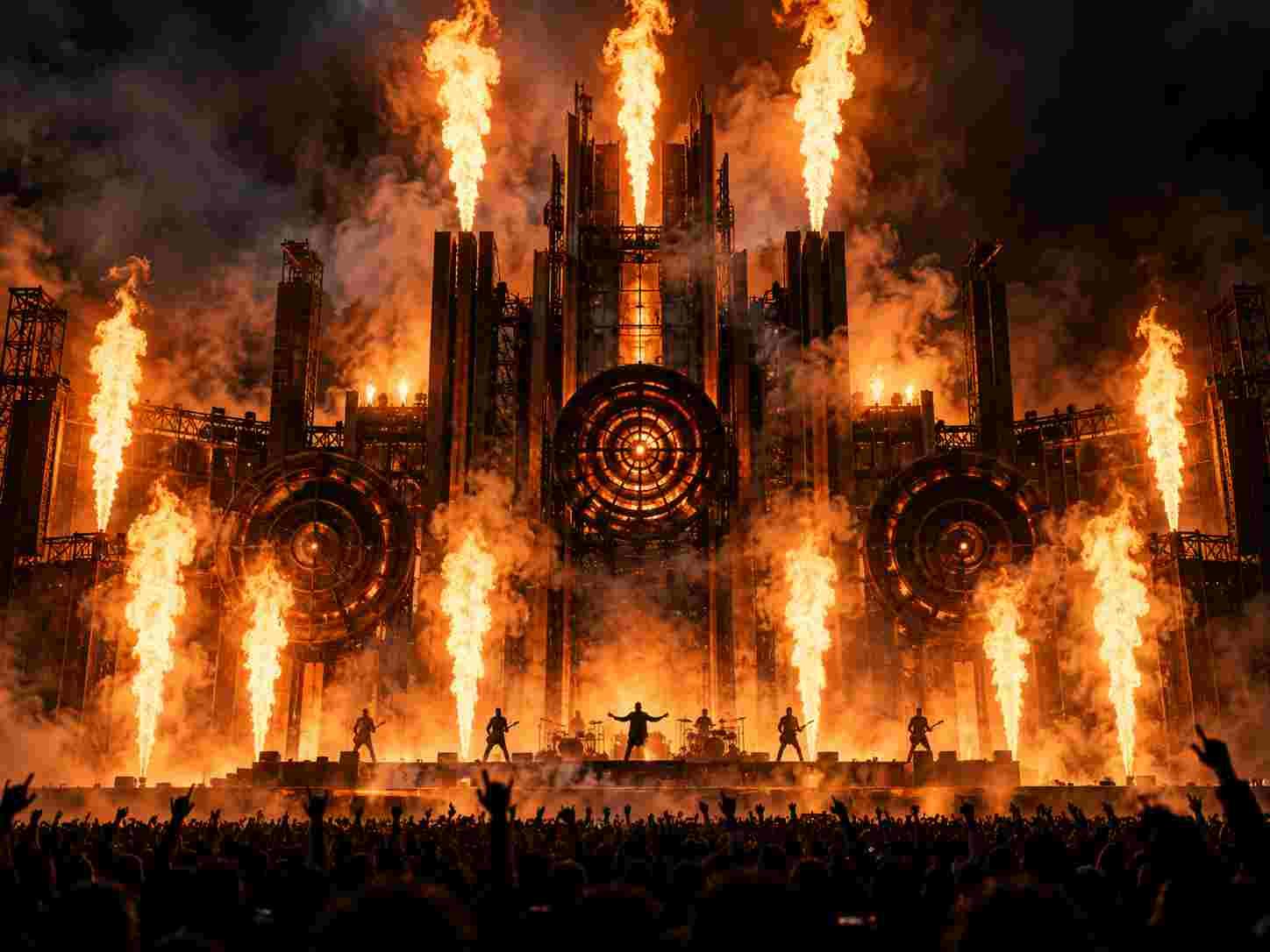
Before the towers of flame, before stadiums seemed to glow around them, Rammstein’s relationship with fire began on a much smaller scale.
It began, according to Till Lindemann, with discomfort.
In an interview with Rolling Stone, Lindemann remembered feeling exposed when he moved from behind the drums to the front of the stage. He wore sunglasses because he struggled with the audience staring at him. He described having stage fright and looking for something that could compensate for the unease of simply standing there as a frontman.
That was when fire entered the picture.
A friend had given him two small pyrotechnic fountains. Lindemann began using them onstage. The experiments escalated from there, sometimes in ways that would be unthinkable in the tightly controlled productions Rammstein mount today. What started as something to hide behind — or perhaps to compete with — gradually became part of the performance itself.
But the interesting part of the story is not that Rammstein discovered fire. Rock bands had used pyrotechnics long before them. It is what Rammstein eventually did with it.
FROM EXPERIMENT TO SYSTEM
The early Rammstein performance style was already unusually severe. Keyboardist Christian “Flake” Lorenz recalled that at the band’s first proper concert they largely stood still, played without smiling and barely moved. The result, he remembered, felt threatening.
Fire fitted naturally into that world. It added movement without requiring Rammstein to behave like a conventional rock band. Instead of a frontman filling every empty space with gestures, the stage itself could become active.
Those early experiments, however, came with obvious risks.
A widely documented turning point came during a 1996 Berlin performance, when a burning stage element fell during the show. Retrospective accounts disagree about whether — and how many — people were injured, so the details should be treated cautiously. What matters to Rammstein’s later story is what followed: the pyrotechnics became increasingly professionalized.
Lindemann underwent formal pyrotechnics training. At the same time, specialists became fundamental to turning the band’s ideas into effects that could be repeated safely night after night.
Among the most important figures in that transformation was Nicolai Sabottka, whose company FFP became deeply involved in Rammstein’s special-effects production.
The difference was enormous. Fire was no longer simply something added to a concert. It became something that had to be designed.
ENGINEERING THE IMPOSSIBLE
Sabottka has described a collaborative process in which new possibilities are presented to the band, ideas are developed, and then the difficult questions begin: Can the effect actually be built? Can it work repeatedly? Can it be approved? Can it coexist safely with performers, crew, venues and audiences?
That process changed the meaning of Rammstein’s pyrotechnics.
The apparent chaos seen from the crowd increasingly depended on control behind the scenes.
Safety concepts, custom engineering, testing and cooperation with authorities became part of making the spectacle possible. Sabottka has spoken about the years required to build trust with officials and demonstrate that ambitious effects could be executed within a professional system.
The irony is central to the Rammstein live experience: the more dangerous the show appears, the more planning is required to make it repeatable.
And as the venues grew, fire stopped being merely an object placed on the stage. It began influencing the stage itself.
WHEN THE STAGE HAD TO BECOME FIREPROOF
For Rammstein’s stadium production, designer Florian Wieder described one requirement in particularly simple terms: the stage had to be fireproof.
That statement says almost everything about how far the idea had travelled.
The pyrotechnic concept developed by Sabottka, FFP and the band had to be integrated into the architecture of the production. Wieder explained that many of the effects — and the technology supporting them — were developed specifically for the stadium tour.
In other words, Rammstein were no longer building a stage and then deciding where to put the fire.
The fire had become one of the things the stage was built to accommodate.
That is the real transformation.
A pair of small fountains used by an uncomfortable young frontman had evolved into an entire visual language: flame, smoke, steel, light and music operating as parts of the same machine.
Not every member of Rammstein has always viewed the scale of the spectacle in exactly the same way. Lindemann and Lorenz have acknowledged the tension between show and music — the question of whether the production can become so large that it threatens to overshadow the songs.
That tension may be precisely why the formula works when it does. The fire is most effective not when it exists for its own sake, but when it becomes punctuation: an extension of a riff, a rhythm, a dramatic pause or a physical movement onstage.
FROM TWO FOUNTAINS TO A STADIUM
More than three decades after Rammstein formed, that evolution can now be seen at its largest scale.
Rammstein — Live in Mexico City, filmed across three sold-out nights at Foro Sol at the end of the band’s North American stadium run, is scheduled to reach cinemas worldwide from November 4, 2026, with the live album following on November 20.
The official presentation of the film emphasizes monumental staging, industrial architecture and a stadium transformed by flame — a long way from two small fountains in the hands of a frontman trying to find his place onstage.
Yet the connection between those two moments is surprisingly direct.
Fire gave Lindemann something to do when standing at the front felt unnatural. Then Rammstein learned to control it. Specialists learned to engineer it. Designers learned to build around it. Eventually audiences came to expect it.
Somewhere along that path, the effect stopped feeling like an addition to a Rammstein concert.
It became part of what a Rammstein concert is.
THE STORIES BEHIND THE NOISE
SOURCES & LINKS
https://www.loudersound.com/features/we-interviewed-the-man-who-sets-rammstein-on-fire
Metal1.info — Interview with Nicolai Sabottka / Rammstein Pyrotechnics
Metal1.info — Interview with Florian Wieder / Rammstein Stage Design
https://www.rammstein.de/en/news/rammstein-live-in-mexico-city-presale